Uncategorized

Register now for the Financial Literacy and Economic Education Conference

Register now for the Council for Economic Education’s 56th Annual Financial Literacy & Economic Education Conference.

The Financial Literacy & Economic Education conference is scheduled for October 6-7 in Brooklyn, New York and will include over 100 workshops where attendees will learn to integrate personal finance and economics into the classroom.

Other reasons to attend include the following.

  • Outstanding networking opportunities – meet with other teachers and learn how they’re tackling the challenges of economic and financial literacy education.
  • Conference sessions and workshops will provide actionable tactics that will help incorporate economics and financial literacy in classes.
  • Gain valuable perspectives from the impressive line up of guest speakers.
  • Earn certificates of completion that may be applied toward CEU requirements.

To register, click here. Registration includes all conference sessions, the Friday evening reception, the awards dinner, the teacher’s breakfast and the teacher’s recognition luncheon. Register before June 30 and save 10 percent when using the code: Educator at checkout.

For questions, please contact Rosalie Polanco at rpolanco@councilforeconed.org.

Uncategorized

Junior Achievement Biztown Summer Camp

Junior Achievement will be offering the fourth BizTown Summer Camp for children ages 10-13 (current 4th-6th grade students). The summer camp is an indoor, academic camp that will focus on financial literacy, entrepreneurship, teamwork and, of course, fun! 

There are three sessions of camp offered at the JA Biztown Summer Camp Biztown location – 6100 Grand Avenue, Des Moines. Sessions will be from 9 am- 3 pm on June 12-16, June 26-30 and July 17-21.

With having a limit of 65 children per camp week, the sessions are filling up fast. To view availability and to register, click here. 

The camp fee is $200 and a $15 sibling discount is offered for a second camper.

For more information, contact Deb Schneider at deb@jacentraliowa.org.


News/Accolades

New Social Studies Standards incorporates Financial Literacy

DE_logo

On May 11th, a press release from the Iowa Department of Education revealed the approval of new standards for Social Studies.  Members of the State Board of Education adopted the new statewide social studies standards. Updating the standards was a process that began over a year ago.  The press release reports that the new social studies standards will:

Weave in Iowa history and financial literacy, which were not reflected in the previous social studies standards.

To read the whole press release go to: https://www.educateiowa.gov/article/2017/05/11/state-board-education-adopts-new-social-studies-standards

Uncategorized

Financial Literacy and Education Commission public meeting to be held Wednesday, May 24

The next public meeting of the Financial Literacy and Education Commission (FLEC) is scheduled for Wednesday, May 27, from 9 – 11:30 a.m. Eastern Time. The financial literacy results from the 2015 Programme for International Student Assessment (PISA) will be discussed.

The meeting will be held at the U.S. Department of the Treasury in Washington, D.C., but individuals can join via live webcast at this link.

If you have questions in regards to the meeting, email ofe@treasury.gov.

Uncategorized

Financial literacy resources for the classroom

Are you looking for educational materials to wrap up the school year with? If so, the Iowa Financial Literacy Network has compiled a list of financial literacy resources that may help – see the list below!

Personal Finance 101 Short videos on many key financial concepts

High School Financial Planning ProgramFocuses on basic personal finance skills that are relevant to high school teens

My Classroom Economy- Helps stimulate a real economy in the confines of a classroom

Chair the Fed- Policy game by the Federal Reserve Bank of San Francisco that helps students understand the role of monetary policy in the economy

We the Economy- A collection of short films that explain economic concepts

How the Market Works- Simulation that allows students to practice playing the marketing in real time

Major Financial Decisions- Tools and resources that can help with life’s major financial decisions

Fish Economics- Free economics lesson plans, lectures and a 10-part series on building an economy

Uncategorized

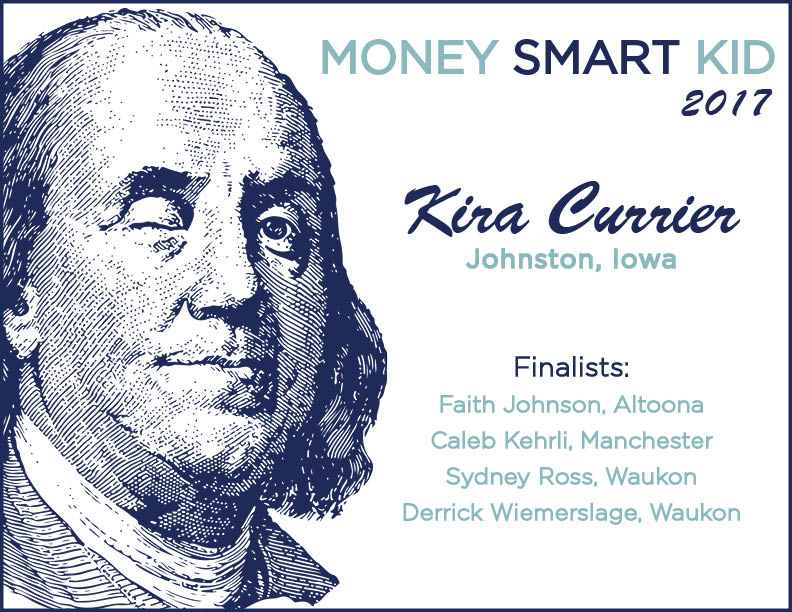
Iowa middle schooler Kira Currier named 2017 Money Smart Kid


Kira Currier, an eighth-grader at Johnston Middle School, has won the statewide financial literacy essay contest for Money Smart Week Iowa and has been named Iowa’s 2017 Money Smart Kid. Currier also received $1,000 from the Iowa Bankers Association to put towards her college education. 

“Knowing how financial health and physical health relate to one another is an important aspect of financial education, and it is exciting to see these students learn about that relationship through this essay contest,” said Lori Ristau, vice president of marketing and communications at the Iowa Bankers Association. “Iowa banks are committed to helping Iowans reach their financial goals, and providing access to financial education resources through programs like the Money Smart Week Kid essay contest is just one of the many ways banks are helping their communities. We are pleased to sponsor this fun and educational opportunity for Iowa students on behalf of our member banks.”

Approximately 102 students from across the state participated in the essay contest. To be eligible, students had to be in grades seventh through eleventh and submit a 400-word essay. The essay asked students to describe the connection between financial health and physical health and what they can do to become more financially healthy.

The top five essay finalists also participated in an interview with contest judges. From those finalists, Kira Currier was selected to be the 2017 Money Smart Kid.

“There is a larger connection between your workouts and paychecks than you might once have thought,” Currier stated in her award-winning essay. “Educating yourself on healthy financial decisions will help lift weight off your shoulders AND your wallet.”

Currier is the daughter of Larry and Vona Currier and attends Johnston Middle School. In addition to Currier, the four essay finalists were: Caleb Kehrli (Manchester), Derrick Wiemerslage (Waukon), Faith Johnson (Altoona), and Sydney Ross (Waukon).

More information about Money Smart Week is available at www.moneysmartweek.org.


Uncategorized

Governor signs proclamations for financial literacy

Today, April 21, Governor Terry Branstad signed proclamations promoting financial literacy awareness in Iowa. The proclamations declared April 22-29 Money Smart Week in Iowa and declared the month of April as Financial Literacy Awareness Month in Iowa.

Looking for ways to get involved in financial literacy during Financial Literacy Month or during Money Smart Week? Visit the Money Smart Week website for more information about Money Smart Week.

Uncategorized

FDIC pilot shows benefits of financial education programs

The Federal Deposit Insurance Corporation (FDIC) released a report last week outlining the results of its Youth Savings Pilot. The pilot consisted of 21 participating banks carrying out different financial literacy programs to identify the most effective approaches to financial education. The report is essentially a blueprint for creating a successful financial education program.

The participating banks were successful in creating more than 4,500 youth savings accounts and identified several key benefits to providing financial education programs to local schools. A few of those benefits include the fact that financial education helps children build a foundation to improve their financial future while helping banks achieve their goals of supporting their communities. The report also indicates that financial literacy programs help individuals throughout the community build trust with their bank as they see the bank’s commitment to future generations.

Participating banks also offered advice on how to create successful programs. Following are some of the top comments from the report.

Quote: “The program needs to be relevant to kids’ lives. Kids like to see how the skills they are learning have real life value. One way to do that is role-playing.”

Who said it: Richard Martinez, Young Americans Bank, Denver, Colorado.

Why it’s important: For information to stick with a large number of children, they need to know how it applies to their lives. Showing real-world applications to financial education can ensure that children will retain that knowledge into adulthood.

Quote: “Kids [are] talking about spending. Students are having conversations about college debt. They are thinking about saving.”

Who said it: Kimberly Vaughn, Muscle Shoals High School, a partner of First Metro Bank, Muscle Shoals, Alabama.

Why it’s important: This shows that the children who went through this program are motivated to start saving. Getting kids to understand early in their lives what it will cost to achieve their goals can spark a stronger interest in saving.

Quote: “By the end of the school year, the student is more outgoing and has gained confidence.”

Who said it: Kim Drudi, Athol Savings Bank, Athol, Massachusetts.

Why it’s important: Financial education provides much more than knowledge. When that knowledge helps children become more outgoing and confident, they become better equipped to function in the real world.

Quote: “Using students as the educators makes the material relatable.”

Who said it: LaKia Williams, Capital One Financial Corporation, McLean, Virginia.

Why it’s important: When financial education is interactive, it creates stronger engagement among the students, and they can see the application of that knowledge firsthand. By involving students as bank tellers at school branches, those students not only gain financial education, but the role may spark an interest in a future banking career.

Quote: “Students across the board in the early ages are understanding much better the difference in needs versus wants. The upper grades are beginning to understand how money and business works.”

Who said it: Patty Fleming, Treynor Elementary School, a partner of TS Bank, Treynor, Iowa.

Why it’s important: Starting early is important. Financial education is an ongoing process that should begin in elementary school and continue through high school. There are many financial lessons that children can learn about early that will help them advance into more complex subjects as they get older.

Uncategorized

FDIC provides resources to use during National Financial Literacy Month

Did you know April is National Financial Literacy Month? The goal of National Financial Literacy Month is to educate Americans on the importance of financial literacy and to help individuals establish and maintain healthy financial habits.

That sounds great, but what resources are available to help us educate others? Well, the FDIC has many financial education tools to help people of all ages build their financial knowledge and skills.

These tools are free and include lesson plans for educators, materials to help education adults on how bank accounts work, information to help older Americans avoid financial exploitation and much more.

The free resources also include:

  • Money Smart for Young People, Money Smart for Adults, and Money Smart for Older Adults, age-appropriate financial education material available in nine languages.
  • Money Smart for Small Business, in partnership with the U.S. Small Business Administration, which provides useful information for new and aspiring entrepreneurs and is available in English and Spanish.
  • Money Smart News, the FDIC’s newsletter featuring tips, updates, and success stories for financial educators. A recent edition of Money Smart News highlights youth financial capability resources, including an FDIC report to help banks and schools enhance financial education efforts through access to a savings account.
  • Teacher Online Resource Center, which offers resources to help teachers develop financial lessons for children from pre-K through age 20.
  • FDIC Learning Bank, a site that provides information for young people about using money wisely, how banks work, and the differences between types of bank accounts.
  • FDIC Consumer News, an FDIC newsletter, offering practical guidance on how to become a smarter, safer user of financial services.
  • Savings-Related Resources, a website that provides savings-related resources for financial institutions, community-based organizations, and others.

For a full list of the FDIC’s free financial education resources, visit www.fdic.gov/education.